
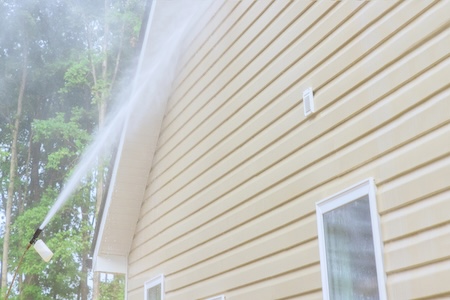
Michigan summers are warm, sticky, and perfect for green algae, mildew, and those black streaks that make siding look tired. If you are weighing your options, the safest way to clean most siding is a professional soft washing service that uses low pressure and targeted cleaners. This guide explains how soft washing protects vinyl, cedar, and fiber cement across the Upper and Lower Peninsulas, and why high pressure can push water behind panels where hidden rot starts.
Why Michigan’s Humid Summers Fuel Algae, Mold, and Black Streaks
From Gladstone and Escanaba in the U.P. to Grand Rapids and Holland along Lake Michigan, summer humidity lingers after storms. Warm days, cool nights, and shade from tall trees trap moisture on north-facing walls. That is where green algae and mildew bloom, and where roof-darkening bacteria like Gloeocapsa magma can streak eaves and upper courses. For a deeper look at roof streaks and safe cleaning, read how to remove black streaks safely.
Soft Washing vs. High Pressure: What Protects Siding Best
High-pressure washing blasts grime away, but the force can open tiny gaps at laps and trim. Water gets pushed behind channels, soaks sheathing, and feeds hidden mold. On older homes with loose J-channels or brittle caulk, that risk jumps.
Soft washing relies on a gentle spray and a calibrated cleaning blend. The solution breaks down the organic growth at the root, then a low-PSI rinse flushes contaminants without driving water where it should not go. Reserve pressure washing for hardscapes like concrete, pavers, and brick where higher force is appropriate.
Material-Specific Settings That Work In Michigan
Pros tailor chemistry and pressure to the surface. Below are typical ranges used by trained technicians in Michigan’s climate. These are not DIY instructions, just the standards your crew follows to protect materials.
Vinyl Siding
Goal: Clear algae film and mildew without loosening laps or flooding insulation. Technicians apply a solution that yields about 0.5% to 1.0% available sodium hypochlorite (SH) on the surface, paired with a plant-safe surfactant at roughly 0.5–1 ounce per gallon for cling. Contact time is kept short in sunlit, humid conditions to prevent drying. Rinsing happens at roughly 100–200 PSI using a wide fan tip from a safe stand-off distance. Do not aim water up into seams or weep holes, since that defeats the purpose of a gentle clean.
Cedar Siding (Cedar Plank and Shakes)
Goal: Lift organic staining without blotching the wood or raising the grain. On unfinished or lightly finished cedar, technicians often choose an oxygenated cleaner such as sodium percarbonate at about 4–8 ounces per gallon of warm water, with a wood-safe surfactant. Dwell is closely monitored, then a controlled rinse in the 100–150 PSI range follows the grain. For sealed or stained cedar, the cleaning blend is reduced and spot-tested first. Never use high pressure on cedar; it scars the fibers and invites faster water absorption later.
Fiber Cement (Hardie Board)
Goal: Remove algae film and soot without lifting paint or forcing moisture behind boards. A mild soft-wash blend that yields about 0.3% to 0.6% SH on the surface with a nonionic surfactant is typical. Rinse around 100–200 PSI with a 40-degree fan tip, working top-down to avoid streaking. Avoid close-range nozzles that can etch coatings and keep wand angles shallow along horizontal laps to protect the factory finish.
How Pros Prevent Moisture Behind Siding
Wind off the lakes can push spray into seams. Trained technicians control angle, distance, and sequence so water exits through designed pathways rather than entering the wall system.
- Angle control: Rinse with a shallow, downward angle so water flows out of laps, not into them.
- Low-PSI discipline: Typical finishing rinses stay near 100–200 PSI to protect seams and flashing.
- Section planning: Work from the sunniest wall to the shadiest so dwell times stay predictable.
- Weep awareness: Keep solution off soffit vents and watch weep holes so siding can drain freely.
High pressure at lap joints is the fastest path to hidden moisture. Gentle flow and time do the work in a soft wash, not brute force.
Upper Peninsula vs. Lower Peninsula: Climate Notes That Matter
Upper Peninsula towns like Gladstone and Escanaba see cool nights, morning fog, and dense evergreen shade. Algae tends to reappear fastest on north and bay-facing walls. In the Lower Peninsula, lakeshore corridors from Ludington to Holland get steady humidity and wind-blown grit that sticks to damp siding. Farther inland near Lansing and Ann Arbor, tree shade and midsummer thunderstorms create short, wet-dry cycles that also feed growth.
Professionals adjust on the fly. On breezy bay days in the U.P., angles are flattened and sections are smaller so spray does not drift into soffits. In the L.P., crews rinse longer on walls near irrigation overspray and flower beds where moisture lingers. Seasonal pollen loads are heavier in May and June, so mix strength and dwell are tuned to match.
Chemistry You Can Feel Good About
Michigan homeowners care about plants, pets, and the Great Lakes. That is why crews pre-wet landscaping, use biodegradable surfactants, and apply rinse-then-recheck passes. Typical on-surface targets fall in these pro ranges:
- Vinyl and painted fiber cement: about 0.3%–1.0% SH with a low-foaming surfactant for cling.
- Unfinished cedar: oxygenated cleaner at about 4–8 oz/gal, then gentle rinse with grain.
- Heavier organic film: brief bump within those ranges, followed by extra rinse to neutralize residue.
When cleaning is complete, technicians confirm that runoff pathways are clear and that weep holes are draining. Always finish with a low-PSI rinse on fiber cement and vinyl so residues do not dry into the coating film.
What About Pressure Washing In Michigan?
Pressure washing still has a place. It shines on hardscapes that are built to take force. Use it to refresh driveways in Grand Rapids, paver patios in Traverse City, and brick steps in Marquette. Your crew will adjust nozzles and stand-off to avoid joint sand loss and etching. For siding, though, the safer, longer-lasting clean comes from pro soft wash chemistry and a calm rinse.
If you want a one-stop plan for home exteriors, see our professional soft washing and pair it with targeted hardscape care from the pressure washing team when needed. For a broad view of other offerings that keep your property looking sharp, browse the categories on our services page.
Spotting Moisture Problems Early
Hidden water damage rarely shows up overnight. Watch for telltale signs and call in a pro if you see them in humid months like July and August.
- Musty odor indoors after heavy rain or wind-driven storms
- Warped trim or ripples near vinyl laps and J-channels
- Darkened sheathing lines telegraphing through painted fiber cement
- Peeling paint at lower courses where splashback is common
When caught early, a gentle surface reset plus air circulation often solves the problem. Your technician can also suggest gutter or grading fixes if overflow is adding to the issue.
When To Choose Each Method
Here is a quick way to think about it. If the surface is coated, laminated, or wood-based, soft washing is usually right. If it is mineral and tough, pressure washing likely fits.
Pick soft washing for vinyl, painted Hardie board, and cedar. Choose pressure washing for concrete, brick, and pavers. If you are unsure, start with a gentle test area and let a trained eye confirm the plan. A wrong guess with pressure can undo years of weathering in seconds, while soft washing gives room to adjust blend and dwell.
Looking for trusted soft washing Michigan help that keeps your siding safe in a humid climate? InfiniClean uses proven low-pressure methods and eco-conscious chemistry to restore curb appeal without risking water intrusion.
Ready To Restore Your Siding Safely
Bring back the original color of your vinyl, cedar, or Hardie board and keep moisture where it belongs: outside your walls. Talk with a Michigan soft wash specialist at 906-399-1833 or schedule service through our page for soft washing. You will get clear communication, careful protection for your landscape, and results that hold up through our humid summers and long winters.
If you also need concrete or paver care, your technician can coordinate with the pressure washing team so everything is cleaned in the right order. For roof streaks near eaves or dormers, this related guide explains how pros remove black streaks safely without harsh force.